
If someone on your team has an opioid overdose at work, the first few minutes decide what happens next. Naloxone, often sold as the brand Narcan, can reverse it in that window. The Bureau of Labor Statistics recorded 512 unintentional overdose deaths in US workplaces in 2023, close to 10% of all occupational fatalities that year.
Naloxone is available over the counter, no prescription needed, and it's safe to use even if the person turns out not to have opioids in their system. Keep it where you'd keep a first aid kit or an AED, somewhere obvious, not buried in a supply closet.
What New York Law Requires
Labor Law Section 27-f, enacted December 13, 2025 and amended in February 2026, requires private employers who must keep OSHA first aid supplies on-site (under 29 CFR 1910.151) to add an opioid antagonist, naloxone, for instance, to those supplies. The requirement takes effect December 12, 2026. It excludes government employers; this is a private-sector rule only.
The February amendment clarified two things you'll want to know. "Employer" means any business entity, not the state or its political subdivisions. "Opioid antagonist" follows the definition in Public Health Law Section 3309: any FDA-approved drug that reverses an opioid's effects. Naloxone qualifies, and so does anything else the Department of Health approves for the same purpose.
If you run the first aid program, this lands on your desk. New York's Department of Labor and Department of Health still need to issue the regulations that will spell out how many units you'll need and how training should work.
Proposed Regulations
Section 27-f directs the state to issue regulations on quantities of opioid antagonists and employee training. Here are the proposed regulations as they currently stand:
- There is no set number of doses that a workplace needs to keep on hand. Instead, each business needs to have a "sufficient number" of antagonists to respond quickly to a suspected overdose. That number is determined by the facility's size, layout, number of employees, and whether the public has access to the building, among other factors.
- The opioid antagonists need to be easily accessible, considering the building's layout including multiple floors, locked doors, or long distances. The proposed regulations specifically discourage placing them in locked drawers or rooms, though they do acknowledge the possibility of restricting storage where there is a security or safety concern.
- Employers should recruit employee volunteers to be trained on how to recognize an opioid overdose, administer first aid, call for EMS, and assist until help arrives. This training should be consistent with materials published by a department of health in New York state.
- At least one trained employee should be present during business hours, including multiple shifts and extended hours.
The comment period for these regulations ends on November 22, 2026, and the language and requirements may change before they are finalized.
Why This Matters Outside New York, Too
New York is the first state to pass a requirement like this. A federal bill, the WORK to Save Lives Act, reached Congress in February 2026, but it took a different approach: it would direct the Department of Labor to issue voluntary guidance, not a mandate like New York's.
What's in the Overdose Kit
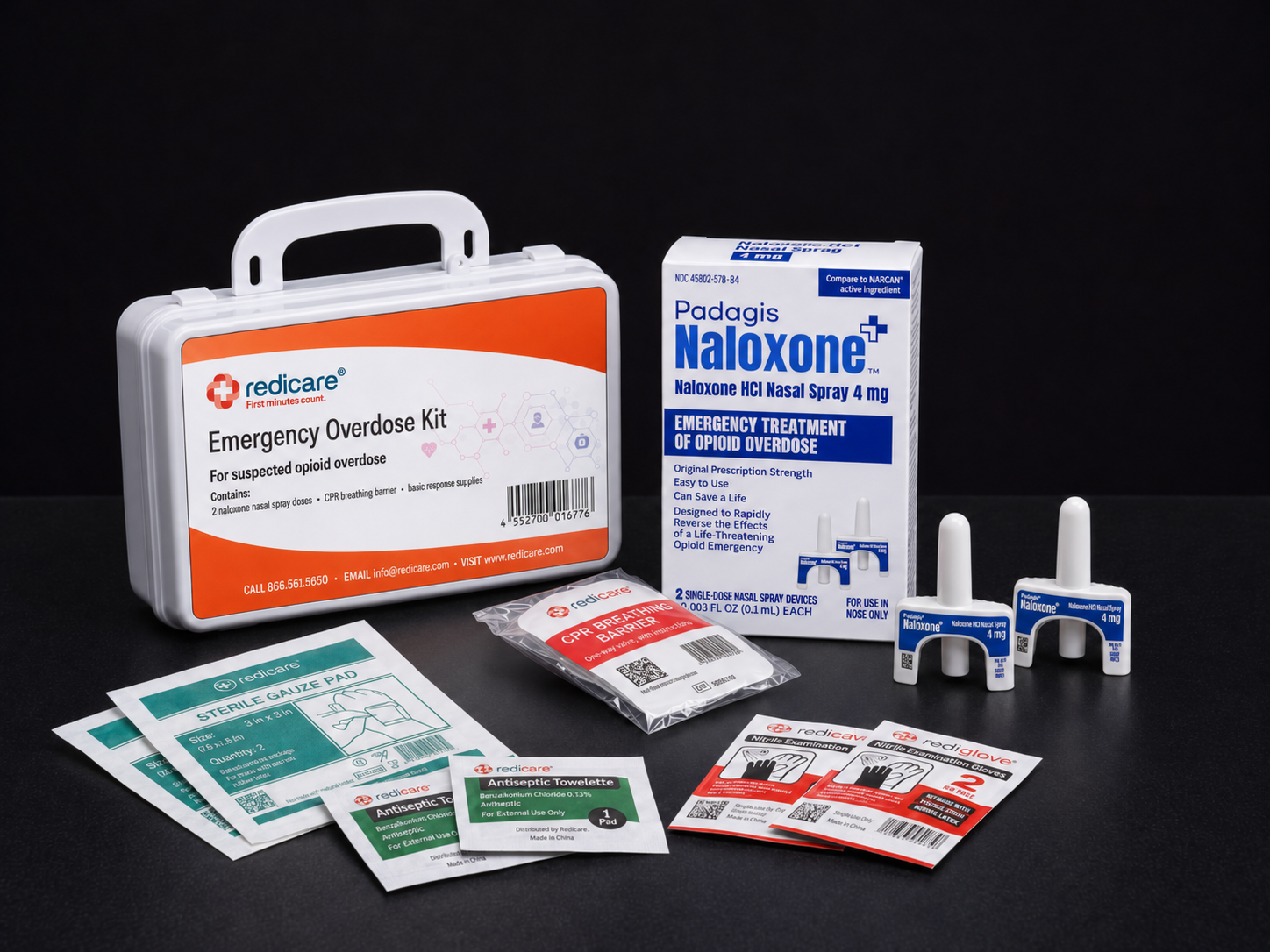
Redicare offers an Overdose Kit as part of your Redicare cabinet. It provides the naloxone needed to prevent a fatal outcome in those critical first minutes of an opioid overdose.
Adding this to your first aid cabinets starts with a conversation. Talk to one of our specialists about what it looks like for your program.
Frequently Asked Questions
Does this apply to us if we're not in New York?
No. Section 27-f only covers private employers in New York State.
What counts as an "opioid antagonist" under the law?
Any FDA-approved drug that reverses opioid effects, per Public Health Law Section 3309. Naloxone is the main example, but the definition isn't limited to it.
Which OTC naloxone products are available?
FDA-approved OTC options include Narcan, Padagis naloxone, Rextovy, and RiVive. Two doses of naloxone typically cost less than $50 on average, though prices vary by retailer.
Get Ready for December 12, 2026
Fill out the form to get a guide and checklist on how to get your workplace ready for the Labor Law Section 27-f delivered to your inbox.