
If an accident happens in your workplace today, would your team know what to do in the first few minutes?
When an injury or sudden illness occurs, professional medical care takes time to arrive. How your team responds during those first few minutes can matter.
Workplace injuries are more common than many businesses and organizations realize. According to the U.S. Bureau of Labor Statistics, private industry employers reported 2.5 million nonfatal workplace injuries and illnesses in 2024. That same year, a worker died from a work-related injury every 104 minutes.
Even workplaces with strong safety programs can still face injuries, sudden illnesses, and other medical emergencies. A first aid kit is only one part of preparedness. Your workplace also needs appropriate equipment, trained people, and clear procedures that work together when an emergency occurs.
OSHA has cited medical literature showing the importance of providing first aid within the first few minutes following serious injuries. Preparedness is part of workplace emergency response.
This guide explains what workplace first aid means, why it matters, what OSHA requires, how ANSI/ISEA Z308.1-2026 applies to first aid kits as well as ANSI/ISEA Z358.1, and how to build and manage a first aid program that works for your workplace.
What is workplace first aid?
The definition of workplace first aid is the immediate medical attention and emergency care provided to an employee at the location where an injury or sudden illness occurs. It combines appropriate first aid supplies, accessible equipment, trained personnel, and emergency procedures to provide immediate assistance until professional medical help arrives.
Therefore, workplace first aid is more than just having a first aid kit somewhere in the facility. The supplies should match the workplace's hazards, employees should know how to respond, and those resources need to be accessible when and where they're needed.
For safety, facilities, and HR teams, understanding workplace first aid means looking beyond individual supplies or training certificates. It means asking whether employees can actually receive appropriate first aid during those critical first minutes of an emergency.
What does workplace first aid include?
The key elements of a workplace first aid program go beyond what’s stored in a cabinet. The program should also provide a planned response to injuries and illnesses, supported by appropriate supplies, trained people, and clear procedures.
OSHA’s Best Practices Guide identifies several elements of a workplace first aid program such as:
- Assessing workplace risk: Identify hazards that could cause worker injury or illness.
- Providing appropriate supplies and equipment: Make sure sufficient first aid supplies and equipment are readily accessible.
- Training first aid providers: Assign and train people to provide first aid appropriate to the workplace.
- Educating employees: Make sure workers understand the first aid program and what to do if a coworker is injured or becomes ill.
- Putting policies in writing: Document your first aid policies and procedures so people know how to respond when an emergency happens.
- Evaluating the program: Regularly review and update the program as workplace risks and needs change.
For example, a well-stocked first aid cabinet doesn't help much if your employees don't know where it is. Likewise, trained first aid providers need quick access to the equipment they may need.
"A well-stocked first aid cabinet doesn't help much if your employees don't know where it is."
What is the purpose of workplace first aid?
The purpose of workplace first aid is to provide immediate care when an injury or sudden illness occurs, while the person waits for emergency medical treatment or EMS.
That initial response can help minimize the effects of an accident or exposure and, in some emergencies, help stabilize a person until professional medical care arrives.
This makes first aid an important part of workplace emergency preparedness. First aid does not replace professional medical care. It gives employees a prepared response during the gap between an incident and the arrival of professional help.
That response may be relatively simple, such as treating a minor cut, or more urgent, such as providing CPR and using an AED during a cardiac emergency.
A prepared first aid program means employees aren't figuring out what to do for the first time during an emergency.
Workplace first aid vs. workplace safety
Workplace first aid and workplace safety go hand in hand, but they do different jobs.
Workplace safety focuses on preventing injuries and illnesses. Workplace first aid is about knowing what to do when one happens.
Safety programs help identify hazards and put measures in place to keep people from getting hurt. A first aid program prepares your team to respond when something still goes wrong.
Think of them as two parts of the same system:
Workplace safety asks: How can we prevent this from happening?
Workplace first aid asks: What will we do if it happens anyway?
That's why first aid should be integrated into the broader workplace safety and emergency-response program. The hazards in your workplace should help shape your first aid program; from the supplies and equipment you keep on hand, to the training your employees receive and the procedures they follow.
In other words, prevention comes first, but preparedness still matters.
Even a strong safety program can't guarantee that every injury, illness, or medical emergency will be prevented. A workplace first aid program helps make sure your team is ready for what happens next.
Why workplace first aid matters: the safety and business case
Workplace first aid matters because emergency medical services take an average of 7 to 8 minutes to arrive after a 911 call, and over 14 minutes in rural areas, so coworkers are often the only help available in the first critical minutes. OSHA recommends that a workplace first aid program include readily accessible supplies, equipment, and trained responders to help limit the severity of injuries and illnesses, and the American Heart Association notes that survival from sudden cardiac arrest drops by about 7 to 10% for every minute without defibrillation. Prompt on-site care also protects the business, since injuries treated right away are less likely to turn into emergency room visits, OSHA-recordable cases, and lost workdays.
Nobody likes picturing a coworker getting hurt. It’s not a comfortable thing to think about, so most people don’t until they have to. But that’s the problem; the moment something actually happens, whoever’s standing there has to act, ready or not. Preparation isn’t about expecting the worst, it’s about not leaving your people to figure it out on the spot.
Your employees spend a huge chunk of their lives at work, and keeping them safe while they’re there isn’t something you can hand off. That means having a real plan for the moments when “safe” doesn’t hold. Your team may need to provide initial care while waiting for EMS, since professional medical help isn’t always immediately available.
Giving them appropriate supplies, trained responders, and clear procedures means they have a defined way to respond instead of scrambling and that’s a call you get to make now.
OSHA’s Best Practices Guide backs this up: a workplace first aid program should be designed to help minimize the outcome of accidents or exposures, supported by appropriate, readily accessible supplies, equipment, and trained first aid providers.
The first minutes principle
When an emergency happens, you don't get to choose when the response starts.
According to a study, EMS takes an average of 7-8 minutes to arrive at an emergency after a 911 call. In rural areas, the response time increases to more than 14 minutes, with some calls taking even much longer.
That’s not counting the time between the emergency happening and someone actually calling 911. So while calling is always the first step, you need to know what to do while you wait for professional help to arrive.
First aid helps your team respond immediately, before professional medical care arrives. That makes those first few minutes an important part of your emergency response plan.
For example, according to the American Heart Association, for every minute that passes without defibrillation during sudden cardiac arrest, the chance of survival decreases by approximately 7-10%.
The cost of workplace injuries
For leadership, the cost of a workplace injury goes beyond the injury itself.
OSHA estimates that employers pay nearly $1 billion every week in direct workers' compensation costs. Additional indirect expenses include training replacement employees, investigating incidents, repairing damaged equipment, and lost productivity, which makes the overall financial impact even greater.
There's also a cost tied to not having first aid available: when there’s no one trained and no supplies on hand to treat an injury right away, so something that could’ve been handled on-site often ends up as an ER visit instead. The average emergency room visit runs $1,500-$3,000 or more, and if the injury requires treatment beyond basic first aid, it typically has to be logged on your OSHA 300 log, and can affect your workers' comp experience modifier down the line. A minor incident handled well on-site can stay exactly that: minor. One that ends up in the ER often doesn't.
According to the National Safety Council (NSC), work-related injuries resulted in an estimated 102 million lost workdays in 2024. This figure includes time lost from injuries that occurred during the year, as well as ongoing absences resulting from permanently disabling injuries sustained in previous years.
The NSC also estimates that injuries sustained in 2024 will result in 54 million additional lost workdays in future years. These figures show that the effects of a serious workplace injury can extend well beyond the initial incident. First aid is one part of the broader effort to manage that risk.
These figures share a common thread: the longer an injury goes untreated and the more severe it becomes, the bigger its cost, in dollars and in lost time. That's the real value of a first aid program. It won't stop an accident from happening, but it can be the difference between a laceration and an amputation, or a chemical splash that gets flushed in seconds and one that causes permanent vision loss. So, in addition to the fact that no one wants to see a coworker seriously hurt, a less severe injury means a faster recovery, less disruption to your team, and a smaller hit to your operation.
"Work-related injuries resulted in an estimated 102 million lost workdays in 2024."
The business case for being prepared
A first aid program gives your organization a practical response to injuries and illnesses that may still occur despite preventive safety measures.
For safety, facilities, and HR teams, that means ensuring:
- First-aid supplies are appropriate for the workplace and readily accessible.
- Trained responders are available when needed.
- Employees know what to do during an emergency.
- Emergency procedures are clear.
- The program is reviewed and updated as workplace conditions change.
OSHA's guidance specifically recommends evaluating and changing the first aid program to keep it current with emerging workplace risks.
Intro to compliance: OSHA and ANSI
OSHA sets legally enforceable workplace safety requirements, and its first aid standard, 29 CFR 1910.151, requires employers to keep “adequate” first aid supplies “readily available” without requiring a specific kit. ANSI/ISEA Z308.1 is a voluntary industry standard that defines what belongs in a first aid kit, and OSHA’s non-mandatory Appendix A to 1910.151 points to it as a baseline for small worksites, though some states or situations may require it.
Before getting into the specifics, it helps to know how OSHA and ANSI actually relate to each other, since the two get mentioned together a lot and mean different things.
OSHA, or the Occupational Safety and Health Administration, represents the law. It's a federal agency, and its standards, like 29 CFR 1910.151, are legal requirements employers have to follow. An OSHA inspector can cite you for not meeting them.
ANSI, or the American National Standards Institute, does not set the law. ANSI/ISEA Z308.1, the standard that defines what belongs in a compliant first aid kit, is a voluntary industry standard.
OSHA references it as an example of what adequate supplies can look like, but does not require employers to meet it by default, though some states or specific situations may be the exception. OSHA's own language is broader, calling for "adequate" supplies that are "readily available," without specifying ANSI compliance directly.
In fact, OSHA’s Appendix A to 1910.151 points to ANSI Z308.1 as a baseline of what a basic kit should include, "adequate for small worksites," though larger or multi-operation sites need more.
Redicare stocks every first aid cabinet to meet or exceed ANSI/ISEA Z308.1. It's not always a legal requirement, but it's the clearest, most consistent benchmark available for what "adequate" actually means, and it's the standard we hold our programs to regardless of what a given inspection requires.
OSHA first aid requirements and emergency response
OSHA's workplace first aid requirements vary by industry, workplace hazards, and access to professional medical care.
What you need depends on your industry, the hazards your employees face, and how quickly professional medical care can reach your workplace.
For most general-industry employers, the starting point is 29 CFR 1910.151, OSHA's Medical Services and First Aid standard. Other OSHA standards add requirements for specific industries, including construction, logging, and electric power.
The easiest way to understand the requirements is to ask yourself these four questions:
- Do you have access to medical care in near proximity?
- Do you have trained people when you need them?
- Can employees quickly access appropriate supplies?
- And do you have additional requirements based on your workplace hazards or industry?
This section covers federal OSHA requirements. OSHA-approved State Plans may have additional or more stringent requirements, so check the rules that apply to your state and industry.
What does OSHA require for workplace first aid? (29 CFR 1910.151)
Under OSHA's general-industry standard, employers must ensure the ready availability of medical personnel for advice and consultation on plant health matters.
If there isn't an infirmary, clinic, or hospital in near proximity to the workplace that can treat injured employees, the employer must have one or more people adequately trained to provide first aid. Adequate first aid supplies must also be readily available.
Employers therefore need a way to provide immediate care when professional medical treatment isn't close enough to respond promptly.
The specific number of first aid providers and the supplies needed will vary by workplace. OSHA's own guidance says employers should consider their specific workplace needs, including the size and nature of the operation, the hazards employees face, and past injuries.
That's also why the standard says "adequate" instead of a fixed number: a single rule couldn't reasonably cover a two-person office and a 500-person manufacturing floor. "Adequate" puts the responsibility on the employer to actually assess their own risks, rather than checking a generic box.
OSHA first aid training requirements
OSHA does not require every employee in every workplace to become first aid certified.
Under 1910.151(b), employers must have adequately trained personnel available to render first aid when an appropriate infirmary, clinic, or hospital is not in near proximity to the workplace.
What does "near proximity" mean?
OSHA does not give one exact distance or response time in 1910.151 for what counts as "near proximity."
OSHA has, however, interpreted the requirement based on the time it takes for medical assistance to reach an injured employee. For workplaces where serious injuries could occur, OSHA has used 3–4 minutes as a benchmark for emergency medical care when no trained first aid person is available. For lower-risk workplaces, such as some offices, OSHA has recognized that a longer response time may be reasonable.
Near proximity is about timely access to medical care, not simply the physical distance to a hospital. That also means employers can't assume they're covered just because an EMS station happens to be nearby. Under OSHA's interpretation, employers relying on EMS to meet this requirement need to take steps beforehand, like making arrangements with the provider, to actually establish that prompt help will be available when needed. A nearby station alone doesn't establish that.
When evaluating your workplace, consider:
- How quickly can EMS or other professional medical care reach you?
- What types of injuries could reasonably occur?
- Are employees working in remote areas of the facility?
- Could building layout, traffic, security, or other conditions delay help?
OSHA's training requirements are therefore tied to the conditions of the workplace, including the types of injuries that could occur and how quickly emergency medical care can be provided. Employers should also consider whether trained first aid personnel are available for each shift and operation.
Training also needs a hands-on component. OSHA has clarified that online training alone doesn’t meet these standards, since skills like bandaging and CPR can only be learned through actual practice, not instructions alone.
That same requirement applies to AED training. Knowing the steps isn't the same as being able to act under pressure, so watching a video isn't enough to meet the standard.
Some industries have additional training requirements. So don't assume that one training rule applies to every workplace. Start with the OSHA standard that applies to your operation.
What does "readily available" mean?
OSHA requires adequate first aid supplies to be readily available, but it doesn't prescribe one universal number of kits based on employee headcount, floor area, or building size.
In practice, first aid supplies need to be accessible quickly enough for a trained responder to use them effectively.
A cabinet located several hallways away from a production area creates a different response challenge from one positioned near the employees who need it. OSHA specifically recommends placing supplies in easily accessible locations.
Your workplace may need additional kits or supplies when:
- Work areas are spread out
- Multiple operations take place in the same facility
- Employees face different hazards
- Certain supplies are used frequently
- Your workplace or hazards change over time
OSHA's Appendix A also recommends periodically assessing your first aid needs and adjusting supplies as needed. ANSI/ISEA Z308.1-2026 puts a number on that: kits should be inspected at least once a month, or right after they're used following an incident.
OSHA requirements for eyewash stations (1910.151(c))
If employees may be exposed to injurious corrosive materials, such as battery acid and industrial cleaners and solvents, OSHA requires suitable facilities for quickly drenching or flushing the eyes and body to be provided within the work area for immediate emergency use.
This is a separate requirement from simply stocking eye-care supplies in a first aid cabinet.
If employees work with corrosive materials, evaluate where exposure could occur and whether an appropriate flushing facility is immediately accessible.
The exact equipment needed depends on the hazards and applicable requirements. OSHA has also referenced ANSI Z358.1 as guidance for emergency eyewash and shower facilities.
Industry-specific OSHA requirements
| OSHA standard | Applies to | Key first aid requirements | What makes it different? |
|---|---|---|---|
| 1910.151 — General Industry | Most general-industry workplaces | Adequately trained first aid personnel when appropriate medical care isn't in near proximity; adequate first aid supplies must be readily available; emergency flushing facilities are required where corrosive exposure is possible. | General baseline for workplace first aid. (OSHA) |
| 1926.50 — Construction | Construction worksites | Employers must plan for prompt medical attention before work begins; trained first aid personnel must be available when medical care isn't reasonably accessible; supplies must be easily accessible; kits must be checked before each job and at least weekly; transportation or emergency communication must be available. | More specific requirements for changing jobsites, medical access, kit inspections, and emergency communication. (OSHA) |
| 1910.266 — Logging | Logging operations | Requires first aid kits at specified work locations and vehicles; kit contents must meet the mandatory requirements in Appendix A; all employees, including supervisors, must receive first aid and CPR training meeting the standard's requirements. | Much more prescriptive because logging operations can involve remote locations and serious injury hazards. (OSHA) |
| 1910.269 — Electric Power | Electric power generation, transmission and distribution work covered by the standard | Incorporates 1910.151 and adds specific first aid/CPR requirements for employees working on or around exposed energized lines or equipment at 50 volts or more. Field crews generally require at least two trained people at a work location; fixed locations require enough trained personnel so an exposed employee can be reached within 4 minutes. | Adds electrical-shock-specific first aid and CPR requirements, including requirements based on crew type and location. (OSHA) |
Does OSHA require AEDs?
No. OSHA Standards does not generally require employers to provide an automated external defibrillator (AED) in the workplace. OSHA's first aid standards address emergency medical care and first aid preparedness, but they do not specifically require AEDs.
That doesn't mean AEDs aren't an important part of workplace emergency preparedness. OSHA recognizes AEDs as an important lifesaving technology and encourages their availability in workplaces, particularly because survival from sudden cardiac arrest decreases by 7-10% for each minute when CPR and defibrillation are delayed. After 10 minutes, resuscitation rarely succeeds.
Federal OSHA does not specifically require AEDs, but employers should also check whether state or industry-specific requirements apply to their workplace. OSHA-approved State Plans may have requirements that differ from or are more stringent than federal OSHA standards.
ANSI/ISEA Z308.1-2026 first aid kit standards
OSHA requires adequate first aid supplies to be readily available in workplaces where its first aid standards apply, but it does not prescribe one universal first aid kit inventory for every workplace. ANSI/ISEA Z308.1-2026 provides minimum performance requirements for workplace first aid kits and supplies. The standard classifies kits based on factors such as the complexity of the work environment and level of hazards.
What is ANSI/ISEA Z308.1-2026?
ANSI/ISEA Z308.1-2026 covers the supplies and containers used in workplace first aid kits. It classifies kits into Class A and Class B based on the types and risks of injuries they are intended to address, and classifies containers into Types I through IV based on how and where they are used.
Here’s a simple way to remember the difference between them:
- Class = what's inside the kit
- Type = where and how the kit can be used
Class A vs. Class B first aid kits
| Class A | Class B | |
|---|---|---|
| Purpose | Common workplace injuries | More complex or higher-risk environments |
| Typical Setting | Offices, retail and other lower-risk workplaces | Construction, manufacturing, warehouses and other higher-risk settings |
| 1910.266 — Logging | Basic range of first aid supplies | Broader range and greater quantities |
| 1910.269 — Electric Power | Electric power generation, transmission and distribution work covered by the standard | Includes a splint and tourniquet |
Class A kits are intended for common workplace injuries such as cuts, abrasions, minor burns and eye injuries.
Class B kits provide a broader range and quantity of supplies for environments where more serious or complex injuries are more likely.
Class A and Class B are ANSI classifications, not OSHA ones. OSHA doesn't require either specific class of kit. Employers should select the appropriate kit based on the actual hazards and conditions of the workplace, not simply because of what their industry is typically associated with.
How to choose between Class A and Class B
An office, warehouse, or manufacturing facility may each have different first aid needs, so kit selection should be based on the hazards present at the specific worksite.
As a general guide:
- Class A: Designed for workplaces where employees are primarily exposed to common injuries such as minor cuts, abrasions and burns.
- Class B: Intended for workplaces where there is a greater risk of more serious injuries and where additional bleeding-control supplies may be needed.
For example, an office with relatively low-risk activities may have different first aid needs from a manufacturing facility where employees work around machinery.
But employers should assess the actual hazards at their specific worksite rather than selecting a kit based solely on whether they operate an office, warehouse, construction site or other type of business.
OSHA specifically recommends evaluating the types of injuries and illnesses likely to occur and adjusting first aid supplies accordingly.
First aid kit types I–IV
ANSI/ISEA Z308.1-2026 also classifies first aid kit containers according to their intended environment:
| Type | Intended use |
|---|---|
| Type I | Stationary, indoor locations |
| Type II | Portable, indoor locations |
| Type III | Portable use in mobile, indoor or sheltered outdoor environments |
| Type IV | Portable use in mobile or outdoor environments where moisture, corrosion, impact or rough handling are concerns |
For example, a wall-mounted cabinet designed for an indoor office is not necessarily appropriate for a construction crew working outdoors. The container should protect the supplies based on the environment in which the kit will be used.
The bottom line
ANSI/ISEA Z308.1-2026 provides a useful framework for selecting workplace first aid kits, but there is no single kit that is right for every workplace.
Start with the hazards and conditions at your facility, then determine:
- Class → what supplies are appropriate
- Type → what container is appropriate
- Quantity and placement → how many kits you need and where they should be located
ANSI Z358.1 eyewash and shower standard
ANSI/ISEA Z358.1 is a consensus standard that establishes minimum performance and use requirements for emergency eyewash and shower equipment used to treat people exposed to hazardous materials. It covers emergency showers, eyewashes, eye/face washes and combination units, along with supplemental personal wash units and drench hoses.
When is emergency eyewash or shower equipment needed?
Under OSHA 29 CFR 1910.151(c), employers must provide suitable facilities for quick drenching or flushing of the eyes and body when employees may be exposed to injurious corrosive materials. The facilities must be located within the work area for immediate emergency use.
This requirement is based on the hazards present and not simply on whether a workplace has chemicals. OSHA has clarified that an emergency eyewash or shower is required when employees could be exposed to injurious corrosive materials.
This matters even if you're just warehousing corrosive materials, not actively working with them. A container can still drop, split, or leak on its own. The risk is there the moment it's on-site.
How ANSI/ISEA Z358.1 relates to OSHA 1910.151(c)
OSHA 1910.151(c) establishes the requirement. ANSI/ISEA Z358.1 provides guidance for the emergency eyewash and shower equipment used to meet that requirement.
OSHA requires suitable facilities for quick drenching or flushing when employees may be exposed to injurious corrosive materials. However, 1910.151(c) does not specify details such as equipment design, installation, flow, or testing.
That's where ANSI/ISEA Z358.1 comes in. The standard provides detailed requirements for emergency eyewash and shower equipment, including provisions related to installation, performance, testing, maintenance, and use. Among its core requirements: equipment must be able to deliver a continuous, uninterrupted flush of tepid flushing fluid for a full 15 minutes, since that's the window medical guidance identifies as necessary to properly treat a corrosive or caustic exposure.
In practical terms: OSHA tells employers when suitable emergency flushing facilities are required; Z358.1 helps employers determine what appropriate equipment should look like and how it should be installed and maintained.
How to build and manage a workplace first aid program
To build and manage a workplace first aid program, OSHA recommends assessing your workplace’s specific hazards, layout, shifts, headcount, and medical response time, then providing readily accessible first aid supplies and equipment, such as first aid cabinets, AEDs, and eyewash stations, based on that assessment. From there, train employees to respond to the emergencies they could reasonably encounter, put clear emergency procedures in writing, and regularly inspect and update supplies, training, and procedures as workplace conditions change.
We’ve already established that a workplace first aid program should reflect the hazards, people, and conditions of your facility rather than follow a one-size-fits-all checklist. OSHA recommends assessing the specific needs of your workplace and periodically reviewing the program as conditions change.
So what does that look like in practice?
Here are five steps to help you build and manage a first aid program that works for your workplace.
1. Assess your workplace
Start by identifying the hazards and situations your employees could realistically encounter.
- Types of injuries or illnesses: What could happen?
- Workplace size and layout: How quickly can employees reach first aid supplies?
- Work areas and shifts: Do different locations or shifts require separate coverage?
- Number of employees: How many people may need access to first aid?
- Medical response time: How quickly can professional medical care reach the workplace?
Your first aid needs should reflect the actual conditions of your worksite, not simply the number of employees or a generic checklist.
2. Equip your workplace
Provide first aid supplies and emergency equipment based on the needs identified in your workplace assessment.
Depending on your workplace, this may include first aid kits or cabinets, emergency eyewash facilities where applicable, AEDs, or other specialized equipment.
First aid supplies should be readily accessible and available in sufficient quantities for the workplace. OSHA also recommends periodically assessing the adequacy of your supplies and equipment as workplace needs change.
3. Train your people
Equipment is only useful if people know how to respond.
Where OSHA's applicable standard requires trained first aid personnel, employers need to ensure those individuals are adequately trained. Training should reflect the hazards and emergencies employees could reasonably encounter.
Employees should also understand the first aid program, including what to do if a coworker is injured or becomes ill and how to call for help if needed.
4. Establish emergency procedures
Emergency procedures should give employees clear instructions for what to do when an incident occurs.
Your procedures should make it clear:
- How to call for emergency medical assistance
- Who is responsible for responding
- Where first aid and emergency equipment is located
- How employees can reach trained responders
- What to do while waiting for professional medical care
OSHA's first aid guidance recommends putting first aid policies and program elements in writing so employees understand how the program works.
The exact procedures will depend on your workplace, hazards, and applicable OSHA requirements.
5. Inspect and maintain your program
A first aid program requires ongoing maintenance.
Regularly check that supplies and equipment remain available and usable, and review your program when workplace hazards, locations, schedules, or other conditions change. Update training, supplies, equipment, and procedures as needed.
What a well-managed first aid program looks like
A well-managed program is ready before an emergency happens.
Employees know where to find help. Appropriate equipment is accessible. Trained responders know what to do. Emergency procedures are clear. And supplies, equipment, training, and procedures are reviewed as the workplace changes.
The goal isn't simply to have a first aid cabinet on the wall. It's to have a system your people can rely on when they need it.
How often should workplace first aid cabinets be checked?
OSHA doesn’t set a specific inspection schedule for first aid cabinets, but ANSI/ISEA Z308.1-2026 says first aid kits should be inspected at least monthly and immediately after any incident where supplies were used. Workplaces with frequent injuries, multiple shifts, or several work areas may need to check more often, replacing used or expired items and confirming supplies are accessible and in usable condition.
OSHA doesn't set a specific inspection schedule for first aid cabinets. Instead, OSHA's guidance focuses on keeping first aid supplies adequate and readily accessible and reviewing the overall first aid program periodically to make sure it continues to meet the needs of the workplace.
ANSI/ISEA Z308.1-2026, however, does give a concrete baseline: first aid kits should be inspected at least monthly, or immediately after any incident where supplies were used. Frequent inspection is what actually keeps a kit compliant and ready, expired items should be replaced as soon as they're found, and cabinet surfaces should be disinfected regularly, especially after restocking or a first aid incident.
Monthly is the floor, not the ceiling. If your workplace has frequent injuries, multiple shifts, or several work areas, you may need to check supplies more often than that while a small, low-risk office can likely stay closer to the monthly minimum.
At a minimum, your inspection process should make sure that:
- Supplies are present in adequate quantities
- Frequently used items have been replaced
- Items are accessible and easy to locate
- Supplies are in usable condition
- Workplace changes haven't created new first aid needs
OSHA also recommends periodically reviewing the program as workplace hazards, locations, and worker schedules change.
What if you don't have time to manage every cabinet yourself?
Checking one first aid cabinet may be simple. Managing a full program, cabinets, responder bags, AEDs, eyewash stations, bloodborne pathogen kits, and keeping training and recertifications current, means tracking a lot of moving parts at once.
You already have a lot going on your plate, and now you have another critical job to manage. What if there’s a partner who handles all of it for you?
This is where a managed first aid program like Redicare can help.
Redicare works around four connected pieces: we plan your facility's coverage, supply the right equipment, whether that's a fully stocked first aid cabinet, a responder bag organized by emergency type, an AED, or eyewash stations, train your people so they know how to use it, and service everything on an ongoing schedule so it's always ready, not just installed.
That means less time managing inventory and recertification dates, and more confidence that your equipment and your people are ready when an emergency happens.
Redicare's workplace first aid and safety solutions
A first aid program has a lot of moving parts, and it only gets harder to manage as you add facilities, shifts, or changing hazards to the mix.
That’s where Redicare comes in.
We don’t just install a cabinet and call it done. Redicare plans, supplies, trains, and services your program as one connected system, built around your actual workplace, not a generic checklist.
The Redicare Model: our core solutions
- Plan → Build the program around your workplace.
We get to know your facility, whether that's through your existing floor plans, a LiDAR scan for a full 3D walkthrough, or working directly with your team on-site, and use that picture to figure out where cabinets and other equipment actually need to go based on the risks specific to your space.
- Supply → We put the right equipment in your people’s hands.
Redicare equips your workplace with what it actually needs, whether that’s first aid cabinets, responder bags, AEDs, eyewash stations, bloodborne pathogen kits, or specialized upgrades like an overdose kit, not a generic starter kit.
- Train → We get your people ready to act.
Hands-on training in first aid, CPR, AED use, bleeding control, and bloodborne pathogens, so the people on your floor know what to do the moment it counts, not just in theory.
- Service → We keep it all ready, not just installed.
Scheduled visits, restocked supplies, maintained equipment. One less thing for your team to track on top of everything else they’re already managing.
Redicare's own vans and employees, background-checked and certified, handle your monthly visits. No outside contractors, no unpredictable scheduling, just the same standard of care behind your cabinets showing up to maintain them.
What goes where: the right equipment for the emergency
Not every emergency calls for the same response, and Redicare's approach is about making sure the right equipment is where it needs to be, so your team always knows what to reach for.
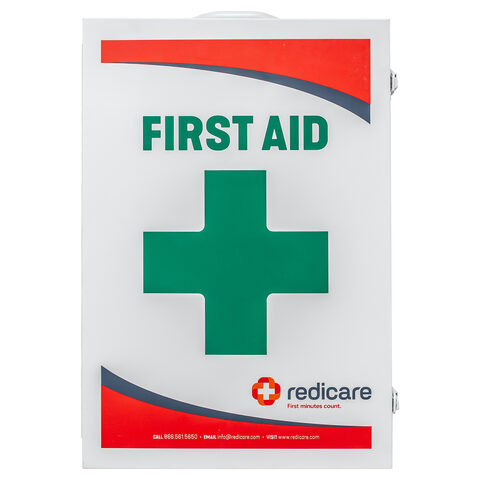
First aid cabinet: For when someone can handle their own care with a little help, a cut that needs a bandage, a minor burn, something that doesn't require anyone to drop what they're doing and run.
Redicare cabinets also include single-dose, tamper-evident OTC medications by default, generic formulations for things like headaches or minor aches, since a quick fix on-site keeps a small distraction from turning into a bigger one. If your workplace has a tablet-free policy, we can accommodate that too.
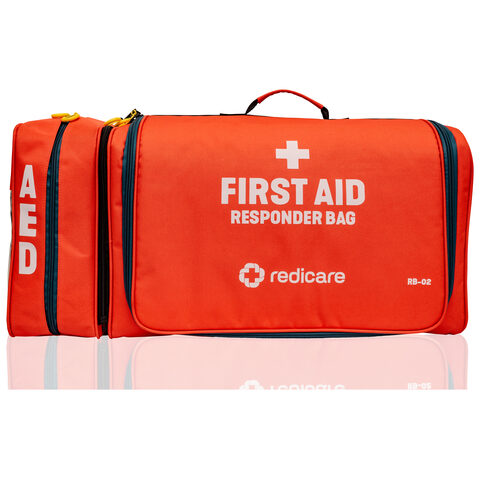
Responder bag: For when word travels that something's happened and someone needs to respond fast. A responder bag is organized by the type of emergency, bleeding control, burns, a resuscitation kit for CPR, so whoever grabs it isn't digging through a bag while every second counts.
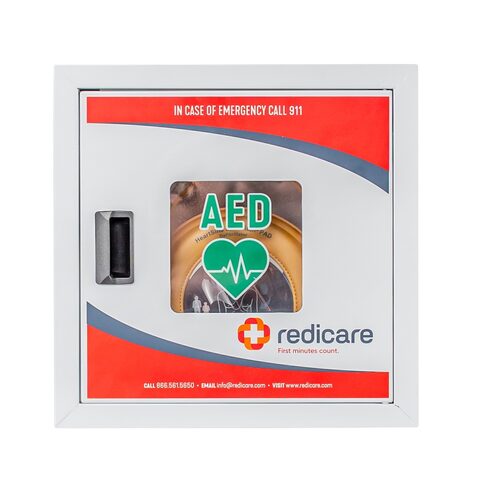
AED: For cardiac emergencies, where immediate action is the difference between life and death. A wall-mounted, alarmed AED cabinet means no one has to go looking for it.
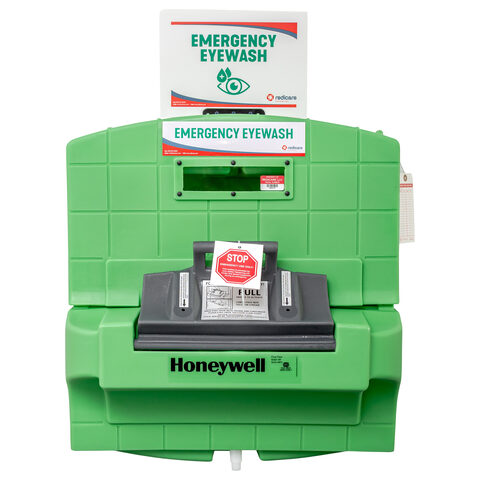
Eyewash station: For a real chemical or debris exposure that requires a full, continuous rinse, not a quick splash. This is the equipment ANSI/ISEA Z358.1 governs, and it needs to be able to sustain that flush for the entire 15-minute window.
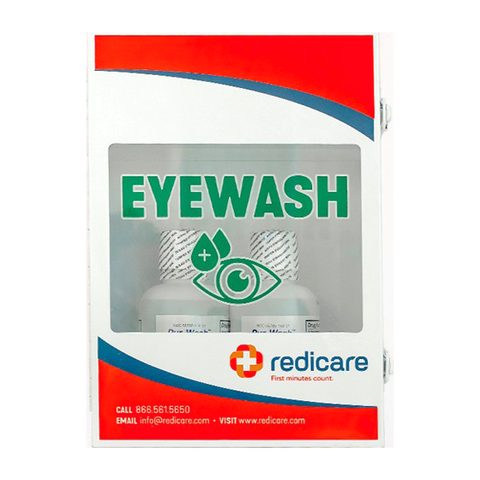
Supplemental eyewash bottles: For everyday irritants, like dust or pollen, where a minor rinse is all that's needed. Not a substitute for a full eyewash station where one is required, but useful for quick relief right where the work happens.
Consistency matters here too. When every cabinet across your facilities is stocked and organized the same way, your team only has to learn where things are once, not relearn a new layout every time they're in a different building or shift. In an emergency, that's not a minor convenience. It's the difference between finding what you need immediately and losing precious seconds searching.
Solutions beyond the building
Not every team spends the whole day inside four walls. If yours doesn’t, a first aid cabinet sitting back at the office isn’t going to help much when something happens on the road.
RediFLEET brings that same readiness to your vehicles and mobile teams. Drivers carry a kit built for the road, and if it gets used, they swap it for a fresh one at your Home Base Cabinet. We handle the rest.
If you’re responsible for safety across more than one site, Redi365 and RediScore give you a way to actually see what’s going on instead of guessing or waiting for a call. Redi365 puts your service history, training records, and incident reports in one place. RediScore boils all of that down to a single number, so you know at a glance whether you’re in good shape or need to make a move.
We’ve been doing this for more than 35 years, and that experience shows up in how we built a program: equipment, training, and service that work together, not three separate things you have to coordinate yourself.
The goal is simple. Keep the right supplies and support in place, so they’re actually there the moment your team needs them.
Workplace first aid compliance checklist
Keeping a workplace first aid program doesn’t have to be complicated. Start with the basics and make sure your first aid supplies, procedures, training arrangements, and emergency equipment match the needs of your workplace.
Here’s a checklist that you can use to help identify areas that may need your attention:
- Are adequate first aid supplies readily available? Employees and designated first aid responders should be able to quickly access supplies when needed.
- Do your first aid supplies match your workplace hazards? The contents of your cabinets or kits should reflect the types of injuries and exposures that could reasonably occur at your facility.
- Can employees easily locate your first aid cabinets and kits? Employees should know where first aid supplies are located, and access should not be unnecessarily restricted.
- Are your first aid supplies inspected and replenished regularly? Check for missing, used, damaged, or expired supplies and replace them as needed.
- Do all work areas, shifts, and locations have adequate first aid coverage? Larger workplaces or facilities with multiple operations may need additional cabinets, equipment, or quantities of supplies.
- Do you have appropriate first aid training arrangements in place? Where 1910.151(b) applies and appropriate medical care is not in near proximity, one or more people must be adequately trained to render first aid.
- Do employees know what to do during a medical emergency? Your emergency procedures should explain how to summon medical assistance and where to find first aid supplies and trained responders.
- Have you addressed any special workplace hazards? Certain risks may require additional first aid supplies, emergency equipment, or facilities beyond a basic first aid kit.
- Is appropriate PPE available for employees who may provide first aid? If employees could reasonably be exposed to blood or other potentially infectious materials, appropriate PPE must be provided under OSHA's bloodborne pathogens requirements.
- Do you periodically reassess your first aid program? Workplace conditions, hazards, staffing, and injury patterns can change, so your first aid provisions should be reviewed and updated accordingly.
A simpler way to stay on top of first aid readiness
Checking cabinets, tracking inventory, replacing used supplies, and keeping multiple locations stocked can quickly become another recurring responsibility for Safety, Facilities, or HR teams.
A managed first aid service can take much of that ongoing work off your team's plate, helping keep workplace first aid cabinets stocked, serviced, and ready when they're needed.
Redicare provides managed first aid services designed to make that ongoing responsibility easier to manage.
Conclusion
Workplace first aid is a system your people can rely on when something goes wrong.
That means assessing your workplace hazards, providing appropriate supplies and equipment, preparing people to respond, establishing clear emergency procedures, and maintaining the program as your workplace changes.
For Safety, Facilities, and HR teams, the challenge is keeping all of those moving parts working over time. That's where the right first aid partner can make a difference.
Redicare brings planning, supplies, training, and ongoing service together to help businesses simplify workplace first aid management and stay prepared for the unexpected.
When an emergency happens, your team should know what to do—and have the resources to do it.